Wool in Focus · Bedding Materials
How Latex and Wool Layers Change Mattress Feel
Latex and wool do different work in a mattress: one pushes back, the other buffers. Together, they can create a sleep surface that feels buoyant yet softened, warm without being sealed off, and more layered than either material alone.
Published November 9, 2026
A mattress is often described as though it had a single personality: firm, soft, plush, supportive. In use, however, it behaves more like a small landscape. The first inch meets the body; the layers beneath it determine whether that first impression deepens, rebounds, or gives way. Add a latex mattress topper, a wool pad, or a combination of the two, and the landscape changes—not dramatically in every case, but in ways that can be felt at the shoulder, the hip, and the warm pocket of air under a duvet.
Latex and wool have distinct materials histories and distinct physical jobs. Latex, whether natural, synthetic, or blended, is an elastic foam. It compresses under weight and recovers, giving a surface its characteristic spring. Wool is a crimped animal fiber, used in batting, felt, and woven cloth. In bedding, it contributes a gentle cushion and insulation, and it can take up and release moisture vapor. The experience of a mattress layered with both depends on more than the names on a label. Thickness, density, firmness, construction, and where each layer sits all matter.
This is a guide to those interactions: what the materials can do, what they cannot promise, and what to examine before deciding that a topper will solve a particular mattress problem. The language of bedding can make a simple choice sound like a referendum on nature. It is more useful to begin with the mechanics.
Two materials, two kinds of response
Latex cushioning is often described as buoyant because it tends to respond quickly when pressure changes. Press a hand into a latex layer and it yields; lift the hand and the material returns toward its original shape. The sensation can be lively, with less of the slow, enveloping impression associated with some other foams. That description is only a starting point. Latex firmness, formulation, thickness, and the mattress underneath can make the actual feel quite different.
Dunlop latex is made through a process in which latex is whipped, poured into a mold, and vulcanized. It is commonly described as having a denser, more consistent feel, though individual products vary. Talalay latex uses additional steps, including expansion in a mold, and is often presented as lighter or more uniform. These names describe manufacturing approaches, not a guarantee of comfort. A firm Dunlop layer and a soft Dunlop layer will not feel alike, and a topper’s performance depends on its dimensions and the support beneath it as well as the process used to make it.
Wool behaves less like a spring and more like a resilient, compressible fiber layer. In a quilted topper, wool batting can soften the immediate contact with the mattress, though it generally does not provide the same deep, elastic contouring as a substantial latex layer. It compresses under the body, and its crimped fibers can retain air within the batting. How much cushion it offers depends on fill weight, quilting, and the condition of the wool.
One useful distinction is between surface feel and support. A top layer can change how a mattress greets the body; it cannot reliably repair a mattress whose underlying support is sagging or structurally unsuitable. Latex can add a more responsive cushion, and wool can add a softer, more breathable-feeling surface, but neither should be treated as a substitute for an adequate mattress base.
What happens when latex and wool are combined?
In a common arrangement, a latex core is wrapped or topped with wool and enclosed in cotton fabric. The latex contributes the main compressive response: it yields beneath pressure and springs back. Wool above it changes the first contact. It can make the surface feel less direct, giving the sleeper a thin, soft buffer between skin or bedding and the latex beneath.
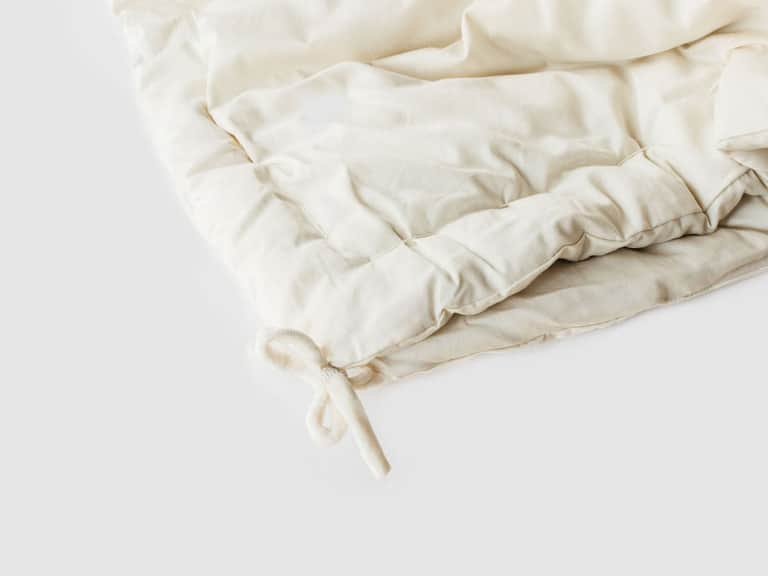
A product illustrating this arrangement is the Organic Latex Topper - 3", described as combining two inches of Dunlop latex with approximately one-half to one inch of wool in an organic cotton sateen encasement. Its construction demonstrates the basic idea: latex provides a cushioning core, while wool forms a surrounding layer. The precise feel will depend on the sleeper, the mattress below it, and the topper’s actual thickness and firmness.
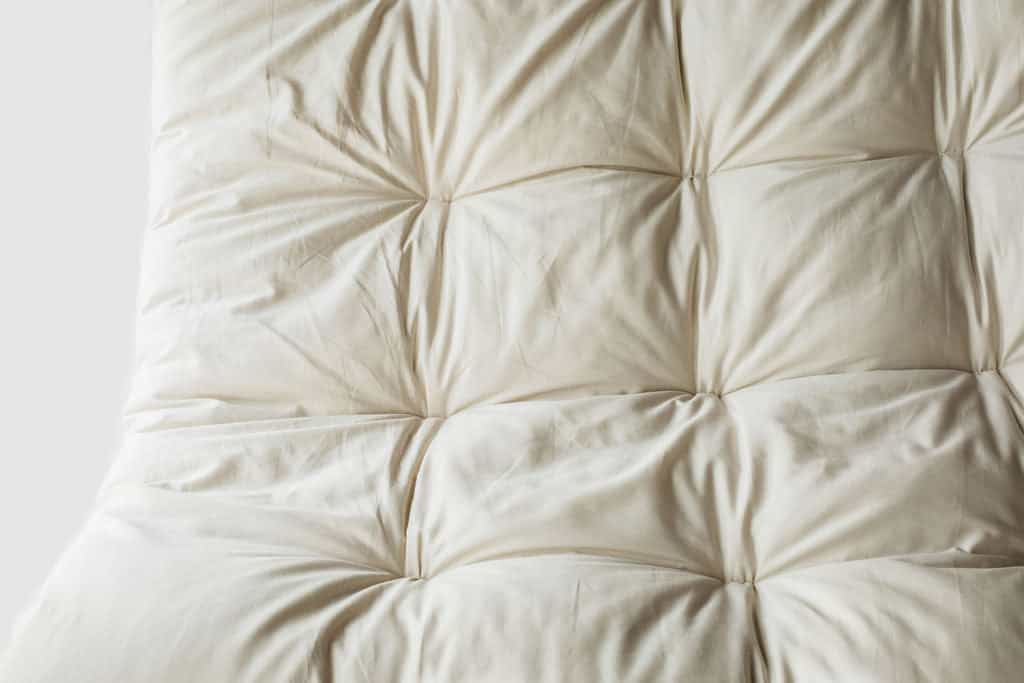
The order and extent of the layers are important. Wool placed above latex is the layer the body encounters first, so it may soften the initial impression. Wool wrapped around latex can also act as a transition between the foam and the cover. A thin layer will make a subtler difference than a deep one; a densely packed batting may feel firmer at first than a lofty, lightly structured one. If the wool is quilted or tufted, the stitching may influence how evenly it settles and how much the filling can shift.
The combination is not simply “more comfortable” by definition. Some people enjoy latex’s spring and want the wool to take the edge off. Others prefer to feel the latex more plainly, or find wool’s initial softness changes the precision of the surface too much. A mattress layer is not a universal adjustment. It is a material arrangement whose usefulness depends on what the sleeper wants changed.
Thickness: a small number with large consequences
Thickness is among the most visible specifications and among the easiest to misread. A thin topper may refresh the surface without altering the mattress’s deeper character. A thicker latex layer can make a more noticeable change in cushioning and may permit more compression before the sleeper reaches the mattress below. Yet the label’s number does not reveal firmness, density, or the distribution of weight across the surface.
For latex, a few additional inches can change how much the material yields before the underlying mattress comes into play. That can be welcome if the mattress feels too hard at the surface, but a very soft or thick layer may also make movement feel less stable to some sleepers. Body weight and sleeping position affect how far the material compresses. Someone who presses more deeply into a topper may experience its firmness differently from a lighter sleeper.
Wool thickness is harder to interpret as a simple measurement because batting can settle and compress in use. Fill weight—the amount of wool in a given size—can offer another clue, but it is not a direct measure of softness. Construction matters: quilting, hand-tufting, fiber preparation, and the shell fabric all affect loft and movement. Wool layers tend to be most useful when the goal is a modest change in surface comfort or thermal character, rather than a dramatic correction to mattress support.
The practical question is not “How thick is thick enough?” but “What do I need the layer to change?” If the mattress feels too firm at the shoulders, a responsive latex layer may provide more cushioning. If the surface feels cool, clammy, or too direct, a wool layer may alter the contact and moisture experience. If the mattress dips noticeably, a topper may follow the dip rather than remove it.
Firmness, pressure, and the feel of moving
Firmness describes a sensation, not a universal scale of support. A topper advertised as medium can feel different on two mattresses, because the base changes how far it can compress. A firm latex layer over a yielding mattress may not feel firm in the same way it would on a rigid base. A soft layer over a mattress that is already soft can amplify sink rather than provide a balanced surface.
Latex’s quick rebound is one reason some sleepers find it easier to change positions on than slower-responding foams. But “easy to move on” is a personal judgment shaped by body weight, layer thickness, and the mattress beneath. A wool layer can soften the surface without recreating the deep contour of a thick foam layer, although its own compression may make the feel less crisp. A combination can therefore occupy an appealing middle ground for some people: responsive underneath, softened above.
Pressure relief is another phrase that deserves careful handling. A mattress layer can distribute pressure differently, but no material guarantees relief for every body or condition. The useful test is whether the surface allows comfortable alignment and whether pressure at the shoulder, hip, or other contact points improves. Persistent pain or numbness is not a problem a product description can diagnose; individual medical concerns belong with a qualified health professional.
Before choosing a topper, consider the mattress’s age and condition, the bed frame, and the sleeper’s position. Side sleepers often seek more cushioning at prominent pressure points; back and stomach sleepers may be more sensitive to excessive sink, though individual needs differ. A topper should be evaluated as part of the complete sleep system—not as a detached slab with a promise printed on its tag.
Wool, warmth, and moisture
Wool’s role in bedding is often summarized as temperature regulation. That phrase can sound like a thermostat hidden in a fiber, which it is not. Wool does not actively cool a sleeper or hold a room at a chosen temperature. Rather, the structure of the fiber and the way wool batting is assembled can influence insulation and moisture exchange. Wool fibers and the spaces among them help retain air, while the material can absorb water vapor without feeling immediately wet in the same way a non-absorbent surface might.
This makes wool relevant to the small climate between the sleeper and the bedding. A wool layer may feel less clammy to some people than a less breathable arrangement, particularly when paired with breathable cotton. Results depend on room conditions, covers, clothing, the sleeper’s own temperature, and the construction of the mattress. Wool is not a cure for night sweats, nor does it eliminate heat; it is one component in a larger system.
Latex also varies in how it feels thermally. A topper’s cover, thickness, perforations, density, and the layers below it all influence airflow and heat retention. Wool placed around latex may affect the immediate surface and moisture experience, but it does not make the underlying foam irrelevant. Nor does the presence of a natural fiber automatically guarantee that a product will feel cool in every room or season.
The best comparison is often a practical one: examine the full construction, use breathable sheets and a suitable cover, and pay attention to whether the sleeping surface feels consistently comfortable over several nights. A single moment of touch cannot reliably predict the temperature of a complete bed through the night.
Questions of sourcing and certification
Material names tell only part of a product’s story. For latex, look for clear information about whether the material is natural, synthetic, or blended, and whether the maker identifies the processing method and relevant certifications. For wool, useful details include the source region, whether the fiber is certified, and how the wool and the surrounding textile are processed. A phrase such as “natural” is not, on its own, a complete account of origin or environmental impact.
Certifications can help establish particular standards, but they should be read for what they cover. A certification may apply to the wool, the cotton shell, or the finished product; those are not necessarily the same claim. Check the certificate’s scope and the organization’s criteria rather than assuming that one label accounts for every stage of production. Questions about animal welfare, farming practices, labor, transport, and processing are related, but no single word on a product page answers all of them.
Traceability is similarly useful when it is specific. A statement naming a country or farm region gives more information than a broad claim of responsible sourcing, but it still does not describe every part of the supply chain. For an educational approach to bedding materials, the habit is simple: distinguish what is documented from what is suggested, and treat sustainability claims as questions to investigate rather than conclusions already settled.
Care: the instructions are part of the construction
Care requirements can determine whether a material combination is convenient in daily life. Latex toppers are generally not items to put casually into a washing machine; cleaning instructions vary, and the manufacturer’s guidance should be followed. A wool wrap or quilted cover may have its own limits. Water, agitation, heat, and compression can affect fibers and construction, so a care label is not an afterthought.
Some wool bedding is designed for spot cleaning and periodic airing; some products have washable covers or specific cold-water instructions. A wool topper described as not machine washable should not be treated like an ordinary sheet. The safest approach is to protect the surface with a fitted sheet or suitable protector, address small spills according to the maker’s directions, and avoid soaking or heating the filling unless the instructions explicitly allow it.
A topper that combines latex and wool may be difficult or impossible to separate for cleaning. Ask whether the cover is removable, whether the latex core is enclosed, and what the maker recommends for each component. Even when a product is labeled washable, the full construction may have restrictions that differ from those for its cover alone.
Rotation can help distribute wear where the construction permits it, but turning a topper over may not be appropriate for every design. Sunning is sometimes recommended for wool bedding, though direct sunlight, heat exposure, and duration should follow the specific care guidance. The guiding principle is unromantic and useful: care for the object that was made, not for a generalized idea of what wool or latex ought to tolerate.
A comparison checklist
When comparing latex mattress toppers and wool-and-latex constructions, it helps to separate the specifications into a few practical questions:
- What is the intended change? More cushioning, a softer first contact, a different thermal feel, or a combination?
- What is the mattress underneath like? Its firmness, condition, and support will affect the topper’s behavior.
- How thick is each layer? Look for separate figures for latex and wool where available, not just an overall product depth.
- What does “firmness” refer to? Check whether the maker provides a rating, a scale, or only a descriptive term.
- Where is the wool placed? A wool layer above latex changes the initial surface encounter; a wrap may surround more of the core.
- What is the fiber content? Confirm whether latex is natural, synthetic, or blended, and whether wool is blended with other filling.
- What can be cleaned? Find out whether the cover is removable and which parts require spot cleaning or professional care.
- What is documented? Seek specific sourcing and certification details, and note which components those claims cover.
If possible, test a comparable surface in person or choose a seller with a clearly stated trial and return policy. A specification sheet can describe a construction; it cannot reproduce a week of sleeping on it. Because toppers are difficult to judge by appearance, a fair trial—where available—can be more informative than a sequence of adjectives.
A layered answer, not a magic one
Latex and wool can make a thoughtful partnership. Latex supplies responsive cushioning; wool can add a softer interface, insulation, and a fiber layer that manages moisture vapor. In a well-considered design, those roles complement one another rather than compete. But the result is shaped by material quality, thickness, firmness, construction, and the mattress beneath.
For readers exploring wool in bedding, the most useful habit is to look past the category label. Ask what the fiber does in this particular construction, where it sits, how much is used, and how the maker expects it to be maintained. Wool’s history as a textile fiber is long; its performance in a modern mattress layer is still a matter of practical details. The difference between a pleasant idea and a comfortable bed often lies in those details.
The goal is not to find a material that does everything. It is to build a surface whose layers do different things well: cushion where needed, respond without excessive resistance, and create a sleeping environment that feels balanced to the person using it. That is a more modest ambition than a perfect mattress—and a more useful one.